



Nama J2 vs Kuvings REVO830: Which Premium Cold-Press Juicer Wins?
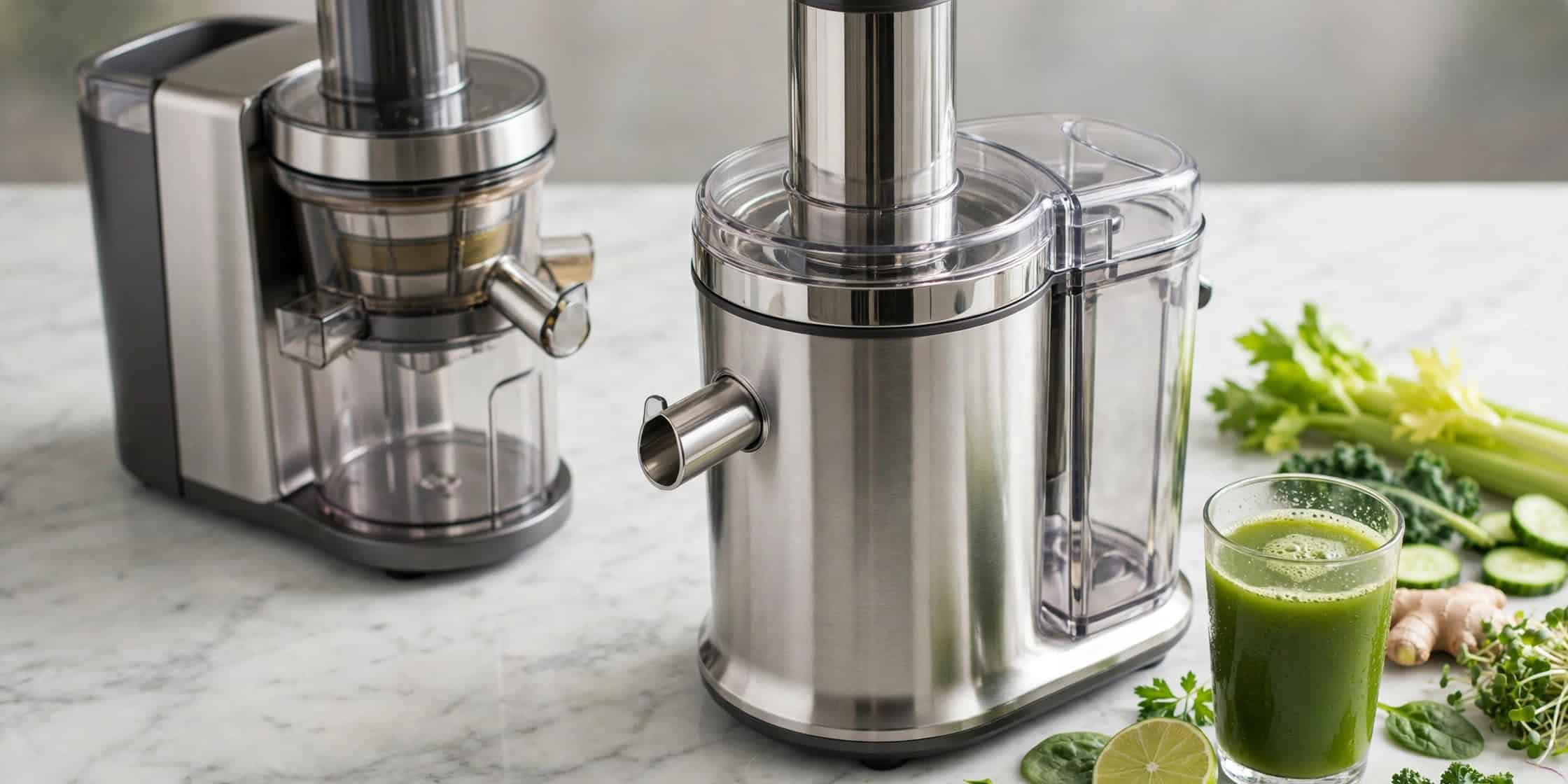
Two machines sit at the very top of the 2026 cold-press juicer rankings: the Nama J2, the consensus “best overall” pick across 2026 expert roundups, and the Kuvings REVO830, the “best premium” power pick. Both cost north of $500. Both are vertical masticating juicers built around the same slow-press idea — crush produce with a slow-turning auger, extract more juice, keep it fresh longer. So what does “premium” actually buy you, and more importantly: which one deserves your counter?
The honest answer is that neither machine is objectively better. They solve the same problem — frictionless, high-yield daily juicing — in different ways. The Nama bets on hands-free operation: load a whole recipe and walk away. Kuvings bets on power and versatility: chutes that cut your produce as it drops in, and extraction that squeezes every drop out. Your winner depends on your routine, your produce, and how much you value convenience versus capability.
This is a companion piece to our Best Masticating Juicers (2026): Compared & Ranked pillar guide, where both machines earned their slots. Here we go head-to-head on every dimension that matters.
Head-to-head comparison table
| Dimension | Nama J2 | Kuvings REVO830 |
|---|---|---|
| Feed system | Large self-feeding hopper — load an entire recipe, close the lid, walk away | Dual feeding tube: 88mm wide chute + 48mm narrow chute, auto-cutting bladeless design |
| Chute size | Full hopper handles whole apples, handfuls of greens, carrot chunks | 88mm wide + 48mm narrow chutes |
| Hands-free operation | True hands-free — the auger feeds itself while you’re away | Requires feeding produce through chutes, but the auto-cutter minimizes pre-cutting |
| Greens / celery handling | Excellent yield on greens and celery — widely cited as a strength | Excellent across greens, celery, hard roots, and soft fruits; built-in celery cutter chops long stalks as they drop |
| Cleanup effort | Straightforward for its class — parts rinse and brush out without a fight (no juicer is truly “easy” to clean) | Standard flagship cleanup; more robust build means heftier parts |
| Size / footprint | Large footprint — measure your counter before buying | Heavier and bulkier than the Nama — a planted, commercial-feeling machine |
| Price* | ~$550 | ~$649 |
| Ideal user | Daily juicers (4+ times a week) who want the routine to be as frictionless as possible | Buyers who want the most capable machine, and anyone juicing lots of long, fibrous ingredients |
*Prices move weekly on Amazon — check the live price via the links below before buying.
Which type of juicer is best?
A quick reset before the head-to-head: there are two fundamentally different kinds of juicer, and both machines here belong to the same side.
Centrifugal juicers are the fast, loud, cheap ones — they shred produce at high speed, introduce heat and air, and the juice foams and oxidizes fast enough that it has to be drunk the same day.
Masticating (cold-press) juicers — slow-juicing machines — crush produce with a slow-turning auger instead. More juice per vegetable, less foam, and juice that keeps 48–72 hours in the fridge in airtight glass.
The Nama J2 and the Kuvings REVO830 are both vertical cold-press machines: slow juicing, high yield, longer freshness. This comparison is not slow-versus-fast — it’s two takes on the premium slow juicer, one optimized for hands-free routine, one for capability.
Benefits of a cold-pressed juicer
Why does the slow side win this tier at all? Three things, and both machines here deliver them:
- High juice yield. A slow-turning auger presses produce instead of shredding it — more juice per pound of produce. Dry pulp coming out of the pulp outlet chute is the visible proof the extraction worked.
- Longer freshness. Cold-pressed juice keeps 48–72 hours refrigerated in airtight glass — which is what makes weekly batch juicing possible. A centrifugal machine’s juice won’t survive the week.
- Less waste, better greens handling. Efficient extraction means less produce wasted per batch, and slow juicers handle the fibrous stuff — leafy greens, celery, kale stems — that separates good machines from great ones. Both machines here are judged on exactly that.
Nama J2 deep-dive: the habit machine
The Nama J2’s signature feature is its large self-feeding hopper. You load an entire recipe — whole apples, handfuls of greens, chunks of carrot — close the lid, and walk away while the auger feeds itself. For daily juicers, that hands-free operation is the difference between a habit that sticks and a machine that gathers dust.
Think about what kills juicing habits: the choreography. Chop produce, feed it piece by piece, stand there pushing greens through a chute for ten minutes. The J2 deletes most of that. Load, lid, walk away, come back to juice. It’s the closest a juicer gets to a coffee maker’s workflow, and for people who juice 4+ times a week, that friction reduction is worth more than any spec number.
Under the hood it runs at low RPM like a true masticating juicer should, producing high-yield, low-foam juice — the cold-press markers that matter. Cleanup is straightforward for its class: parts rinse and brush out without a fight. (The standing caveat: no juicer is truly “easy” to clean. Budget a few honest minutes and rinse immediately after juicing, whatever you buy.)
It handles leafy greens and celery well — the two ingredients that separate good slow juicers from great ones, and exactly what daily green-juice drinkers need. Operation is quiet, which matters when you’re juicing at 6 AM in an apartment.
Strengths: true hands-free hopper; excellent yield on greens and celery; the strongest 2026 review consensus of any machine in its class; quiet operation.
Watch-outs: premium price; large footprint — measure your counter. And while the hopper does the work, you still own the prep and the cleanup.
Who it’s for: daily juicers who want the routine to be as frictionless as possible. If you’ll juice 4+ times a week, the J2 earns its price in habit it preserves. It’s the habit-builder’s machine.
Kuvings REVO830 deep-dive: the power machine
The Kuvings REVO830 is the power pick of the 2026 lineup — Kuvings’ flagship cold-press machine. Its headline feature is the dual-feeding tube: an 88mm wide chute plus a 48mm narrow chute, with an auto-cutting bladeless design — effectively a built-in celery cutter — that chops long ingredients (celery stalks, kale stems, carrots) as they drop in. It requires less pre-cutting than almost anything else in its class.
That auto-cut feature deserves a closer look, because it changes the daily workflow. Most juicers force a choice: wide chute machines want produce in big chunks, narrow chute machines want long strips cut to size. The REVO830’s dual-tube design lets you drop whole pieces down the wide chute while the narrow chute plus the built-in cutter handles the long, fibrous stuff — celery stalks, kale stems — that would tangle or stall lesser machines. You feed it, and it does the chopping.
Build quality is a step above: this is a heavy, planted machine that feels commercial-grade on the counter. That heft is a feature, not a bug — the machine doesn’t wander when processing hard roots. Juice quality is excellent across the board — hard roots, soft fruits, leafy greens — and the pulp comes out notably dry. Visible dry pulp is the telltale sign of efficient extraction, and the REVO830’s pulp is widely cited as among the driest in its class.
Strengths: dual chutes with auto-cut; superb extraction (notably dry pulp); commercial-grade build; handles everything — hard, soft, leafy, fibrous.
Watch-outs: the priciest pick here; heavier and bulkier than the Nama, so it demands more counter commitment.
Who it’s for: buyers who want the most capable machine and are willing to pay flagship money for it. Especially the pick if you juice a lot of long, fibrous ingredients — celery, kale stems, carrots — where the auto-cutter earns its keep daily.
Verdicts by use case
Daily green-juice drinker → Nama J2. Your priority is a routine you’ll actually keep. The self-feeding hopper deletes the daily stand-and-feed chore, and the J2 is widely cited for excellent yield on greens and celery — your two staples. The machine that gets used is the right machine, and the J2 is built to get used.
Celery-juice devotee → Kuvings REVO830. If celery is your daily ritual, the built-in celery cutter matters more than anything else here. Long fibrous stalks are the hardest common ingredient to process, and the REVO830 was designed to chew through them. Its pulp comes out notably dry — visible proof you’re extracting everything from each bunch.
Batch-prep weekly → edge to Kuvings REVO830, with a caveat. If your style is one big juicing session for the week, you want maximum extraction per pound of produce — and the REVO830’s dry-pulp extraction means less produce wasted per batch. The caveat: the dedicated batch king in our pillar guide is actually the Kuvings AUTO10 with its 3-liter batching hopper. If batch volume is the whole job, read that section before choosing between these two flagships.
Set-and-forget habit-builder → Nama J2. This is the J2’s core mission. If your last juicer died of neglect — if the friction of prep, feeding, and standing over the machine is what stands between you and daily juice — the hands-free hopper is the feature that solves your actual problem. Load, lid, walk away.
The budget question: ~$550 versus ~$649 is roughly a $100 gap, and both prices move weekly — re-check the live price via the links above before buying. If $100 decides it, the J2 is also the cheaper machine: you get the best-overall pick for less than the best-premium pick. The $100 buys you the dual-chute auto-cut system, commercial-grade heft, and the driest extraction in the class. Whether that’s worth it depends on how much celery and hard produce you process — heavy fiber users get more value from it.
Frequently asked questions
Which is easier to clean? Neither is effortless — no juicer is truly “easy” to clean. The Nama J2’s parts are widely cited as rinsing and brushing out without a fight, which is as good as this class gets outside the Hurom H70’s strainer-free chamber (the cleanup champion in our pillar guide). The REVO830’s parts are heftier by nature of its commercial-grade build. The real answer for both: rinse parts immediately after juicing. Dried pulp is what makes cleanup miserable, on any machine.
Which handles celery better? Both handle celery well, but differently. The Nama J2 gets excellent celery yield through its self-feeding hopper. The Kuvings REVO830 adds the built-in celery cutter that chops long stalks as they drop in — less prep, less babysitting of fibrous stalks. For occasional celery, either is fine; for a daily celery ritual, the REVO830’s cutter is the meaningful edge.
Is the ~$100 price difference worth it? It depends on your produce. The $100 buys the dual-chute auto-cut system, a heavier commercial-grade build, and the driest pulp extraction in the class. If you juice lots of long, fibrous ingredients — celery, kale stems, carrots — those features pay you back daily. If your routine is mostly mixed recipes dropped in a hopper, the J2 gives you best-overall performance for less. And remember: both prices move weekly, so the real gap on the day you buy may differ from the ~$100 listed here.
Which is better for beginners at the premium level? The Nama J2. If you’re spending flagship money on your first serious juicer, you want the shortest path from box to daily habit — and “load the hopper, close the lid, walk away” is the most forgiving workflow in the category. The REVO830 rewards a user who knows their routine; the J2 builds the routine for you.
Do I still need to pre-cut produce with these? Less than with most juicers, but some. With the J2, whole apples and carrot chunks go in as-is; you’ll still remove hard pits (peach, mango, cherry) and thick citrus rinds. With the REVO830, the auto-cutter handles long stalks, but whole apples still go down the wide chute in sensible sizes. Neither machine asks you to do meaningful knife work — that’s the point of the premium tier.
Conclusion
The Nama J2 and the Kuvings REVO830 are both right — for different people. The J2 wins the habit war: hands-free hopper juicing, the strongest 2026 review consensus in its class, and the cheaper price. The REVO830 wins the capability war: dual auto-cut chutes, a built-in celery cutter, commercial-grade build, and the driest pulp in the lineup.
Choose the J2 if you want juicing to become automatic. Choose the REVO830 if you want the most machine for your money — especially if celery and fibrous produce are your daily drivers. Either way, you’re buying at the top of the 2026 class; the machine that gets used is the right machine.
For the full 2026 lineup — batch, compact, easy-clean, and budget picks — see our Best Masticating Juicers (2026): Compared & Ranked pillar guide.


